
TWO:There was grave discontent and suffering in France, and Marshal Saxe, through General Ligonier, made proposals for peace. The news of these overtures gave great delight in England, but the king and Cumberland were bent on continuing the war. Pelham and Chesterfield advocated acceptance of the terms, but Newcastle sided with the king, to gain favour with him. As the terms, however, could not with decency be bluntly rejected, Cumberland solicited and obtained the post of negotiator in the matter for England; but the Ministers, desirous of peace, foreseeing that the wishes or the hasty temper of Cumberland would[114] soon ruin every chance of accomplishing a treaty, the Earl of Sandwich was sent over to act as assistant to the duke; this meant that he was to overrule, if possible, the mischief Cumberland would be sure to make. Sandwich accordingly hastened over to Holland, and had a secret interview with the Marquis de Puisieulx, the French Minister for Foreign Affairs, and, after much dodging on the part of the marquis, he managed to have the discussion removed from military negotiators to a congress at Aix-la-Chapelle.The young Queen enjoyed, in the new King of Hanover, the advantage of a foil which, with all the force of contrast, placed her character as a constitutional Sovereign in the best possible light. At her accession, the Crown of Hanover, which could not be inherited by a female, was separated from the Crown of England, with which it had been united since the accession of George I. in 1714, and had descended to the Duke of Cumberland, the next surviving male heir of George III. This severance, instead of being regarded as a loss, was really felt as a great relief by the British nation, not only as terminating its connection with German politics, from which nothing but annoyance and expense could result, but, what was regarded as much more important, freeing the country from the presence of the Duke of Cumberland, who was detested for his arbitrary temper. On the 24th of June, Ernest Augustus, King of Hanover, left London, apparently in a very churlish spirit, and breathing hostility to constitutional freedom in the country which was to be cursed by his rule. So strong were his feelings against constitutional government that he had not the grace to receive a deputation of the Chambers, who came to offer him their homage and their congratulations; and on the 5th of July[444] he hastened to issue a proclamation, announcing his intention to abolish the Constitution. He not only did this, but he ejected from their offices, and banished from their country, some of the most eminent professors in the University of G?ttingen. It was thus he inaugurated a rule of iron despotism worse than that of the native princes, who had not the advantage of being brought up in a free country.
THREE:During the months of April and May Florence and all the other towns of Tuscany recovered from the revolutionary fever, and returned to their allegiance. At Bologna the Austrians met with a determined resistance. The garrison consisted of 3,000 men, including some hundreds of the Swiss Guards, who had abandoned the service of the Pope. They defied the Austrians, stating that the Madonna was all for resistance, and was actively engaged in turning aside the rockets of the enemy. But the heavy artillery did its deadly work notwithstanding; and after a short bombardment the white flag was hung out, the city capitulated, and the garrison laid down their arms, but were permitted to march out unmolested. Ancona also capitulated on the 10th, and Ferrara was occupied without resistance by Count Thurn. In fact, the counter-revolution was successful all over Central Italy, except in the Papal States, which now became the centre of universal interest. The leaders of the revolutionary party, chased from the other cities of Italy, were warmly welcomed at Rome, and gladly entered the ranks of its defenders.
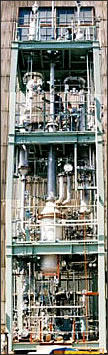
High quality is being demanded in many fields nowadays and so in order to satisfy that we developed a high-purity distillation system in collaboration with Ube industries, Ltd. and Kanto Chemical Co., Inc. The system is used to refine cleaning solutions for the semiconductor industry, medical materials, etc. of high purity (residual ion concentration: 0.01 to 1.0 ppb).
- Our High-purity distillation system provide our clients with high solvent recovery rate, almost 100%.
- The quality of the products/output from our system is very stable, which makes production management very easy, and easier than the conventional ion exchange resin method.
- No emission of waste brings our clients reduction of running cost for environmental measures.
- Our various devices minimize entrainment.
- To prevent the elution of metal, you could ask us the system made of Teflon.
- Our High-purity distillation system has been already proved for solvents that trigger very rapid decomposition reactions, such as hydrogen peroxide.
- Product guide
- Alcohol distillation
- Distillation equipment
- High-purity distillation system
- Membrane separation type solvent dehydration system
- Reactor
- Evaporative concentration equipment
- Coulter spray dryer
- Microwave treatment system
- Filter dryer
- OS filter (continuous vacuum rotating filter)
- Hydrocyclone (liquid cyclone)
- Thermal oil heater (heat medium boiler)
- Process air heater (air heater)
- Ammonia treatment system
- Catalytic deodorizing equipment for ammonia and VOC gas
- Stationary cryogenic storage tank
- Portable cryogenic container
- Cryogenic liquefied gas evaporator